

Ragwort has become a widespread issue for horse and donkey owners, as the plant, which commonly thrives on wasteland and road verges, continues to spread to grazing land. Find out how to keep your donkeys safe from this toxic plant.
Ragwort contains toxic compounds that cause liver damage to equines and other livestock animals, and in many instances can be fatal.
The yellow flowering plant acts as a cumulative poison, and can pose a real danger whether eaten in large quantities in a short period or in small amounts over a longer period of time. While horses and donkeys may instinctively avoid eating ragwort, this is not always the case, particularly when grazing is sparse. It is just as toxic when cut and dried, since this is when the plant loses its bitter taste and will be even more palatable. Owners should be very aware of this plant both in pasture and baled hay/haylage.
There are several methods for removing it and ideally this should be done in spring and summer before ragwort is able to seed. If pulled by hand, gloves should be worn at all stages to ensure the handler’s health and safety.
Ragwort at a glance
Common name: Common ragwort
Latin name: Senecio jacobaea
Usually seen: In paddocks and pasture land, particularly where the land is overgrazed, as well as on road verges and wasteland
When to act: Spring and summer
Need to know: This plant is poisonous to equines and other grazing animals
Read our factsheet
How does ragwort affect livestock and how does poisoning occur?
Horses, ponies, donkeys, mules and cattle are more susceptible to ragwort poisoning than other livestock, and young animals are more at risk than older ones. Poisoning can occur at any time of the year and generally has a cumulative effect. A very small intake over a long period of time can have the same effect as a large intake over a short period. It causes damage to the liver and this may accumulate with continued intake until the function of the liver is compromised and the animal will suffer liver failure. Liver damage can be very insidious, and may not be noticed for months, or even years, by which point the liver may be down to 20% of its functioning capacity. Liver failure occurs when approximately 80% of the liver is damaged. Ingestion of a large amount of ragwort in a short space of time can cause acute poisoning, resulting in death in a matter of days. Despite its bitter taste, equines will eat ragwort especially when food is in short supply. Ragwort becomes more palatable when preserved in hay, haylage or dried grass and can be difficult to distinguish from other plant species in the bale.
It is important to split and examine every bale fed to your animals for any evidence of ragwort – discard any suspicious bales.
What are the clinical signs of ragwort poisoning?
Unfortunately, it is difficult to detect signs of ragwort poisoning before the liver has undergone irreversible damage and symptoms will only become apparent at this late stage. There are no early warning signs. Contact a vet for advice if there are concerns that a donkey has had access to ragwort.
Early symptoms may include:
- Depression
- Loss of condition/poor appetite
- Diarrhoea or constipation
- Photosensitivity (sunburn) affecting unpigmented (pink) skin
- Jaundice (having a yellow appearance on mucous membranes such as gums, conjunctiva or soft tissue surrounding the eyeball).
This may progress to include:
- Restless/aimless and uncoordinated movements/repetitive circling
- May appear to be blind
- Head pressing against solid objects
- Abnormal gait and stance
- Haemorrhage
- Loss of consciousness.
How can I identify ragwort?
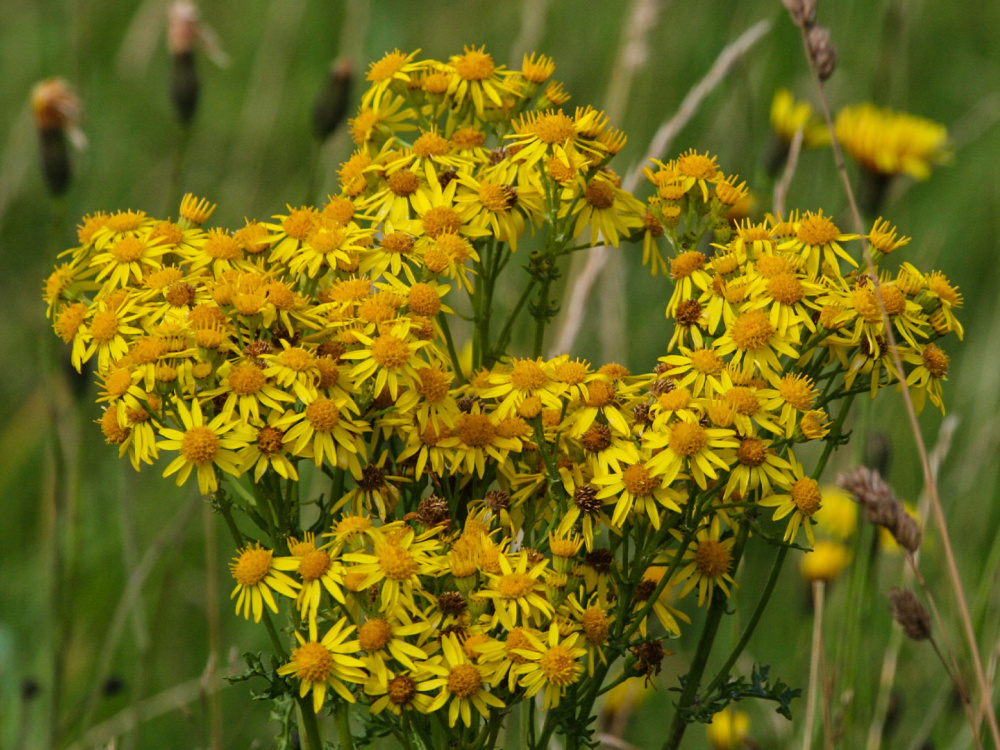
Flowering ragwort can be identified by its mass of bright yellow daisy-like flowers measuring 1.5 - 2 cm across. A mature plant usually stands anywhere between 30-100 cm tall, but can sometimes reach 2 m in height. The lower leaves, stems and roots may have a purple/red tinge. It is harder to identify young plants and those that have gone to seed.
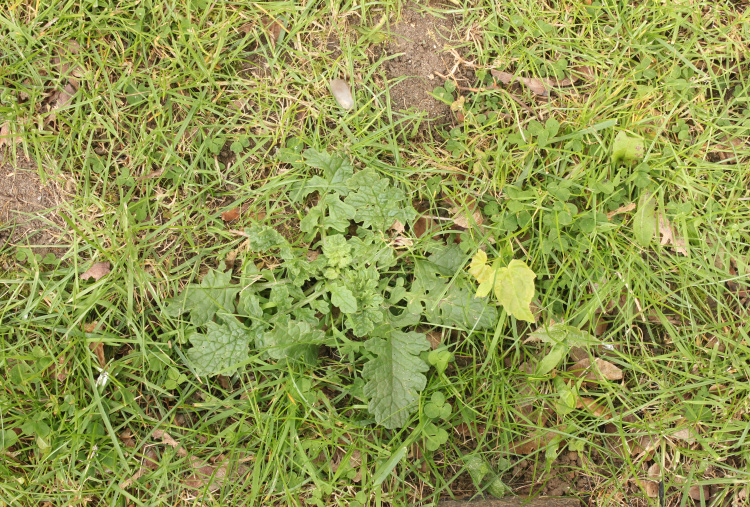
Ragwort is usually biennial, taking two years to reach flowering and maturity, although in some circumstances it can flower in the first year of growth. Seedlings can appear from autumn onwards - the first true leaves, 10-12 mm in length, are hairless and have a characteristic spade shaped blade with a smooth edge. As the plant grows the leaves produced show a gradual increase in the waviness, typical of the older ragwort plants. Leaves also become hairier as the plant gets older.
Rosettes can be found from early spring onwards having a circular cluster of leaves with a ragged appearance, usually deep green on top and covered in a cottony down underneath. The rootstock, basal leaf stalks and lower parts of the stem may have a purplish/ red colour. (If biennial it will over-winter as a rosette and during the second year send up a single leafy stem that will produce numerous flower heads.)
Flowering occurs from May to late October. Ragwort produces masses of tiny seeds from each flower. The seed-head itself has a similar appearance to the commonly recognised dandelion. Once seeds are produced and dispersed on the wind the plant dies back, creating a gap suitable for immediate colonisation by seedlings.
Other species of ragwort, such as marsh ragwort (Senecio aquaticus), hoary ragwort (Senecio erucifolius) and Oxford ragwort (Senecio squalidus) are less common but may still need to be controlled as they may be equally toxic to donkeys or other livestock. Some species of ragwort are relatively rare, such as fen ragwort (Senecio paludosus), which is a protected species and has been reintroduced into several sites in England. Welsh ragwort (Senecio cambrensis) (also sometimes known as Welsh groundsel) is restricted entirely to North Wales.
How can I control ragwort?
Defra have published The Code of Practice on How to Prevent the Spread of Ragwort, and this provides best practice for the control of ragwort. To eliminate the danger to your donkeys it is important to remove all potential sources of poisoning as quickly as possible and to put a control plan in place.
- Consider removing your donkeys from any affected grazing until the ragwort can be removed
- Put effective pasture management in place to prevent re-infestation.
Detection at an early stage will result in easier, quicker and more economical control of infestation than eradication of a well-established infestation.
Pulling/digging
Removal needs to be done before flowering has completed and is more easily achieved when the plant is immature (seedling or rosette) or after heavy rainfall when the ground is soft. As ragwort can be biennial, this method will need to be carried out for at least 2 years. If the pasture has a history of ragwort infestation, this will have to be carried out annually due to the remaining seeds in the soil. It is important to remove as much of the root as possible; ragwort can re-generate from a fragment of root as small as 1 cm. Digging out the entire plant will reduce the possibility of leaving root fragments. Rock salt, bought from any agricultural merchants, poured into the hole after digging helps to kill the remaining roots. Tools can be purchased for the job; ‘Lazy Dog Tool’ or ‘Rag Fork’.
Always cover arms and legs, wear gloves and a facemask to avoid the inhalation of ragwort pollen, or other airborne particles (research on absorption/inhalation is inconclusive but it remains a theoretical possibility).
The pulling of ragwort by machine can be more appropriate for large areas of ragwort. For the machine to work effectively there has to be a significant height difference between the ragwort and other plants.
Cutting
Cutting at the early flowering stage reduces seed production. It is acceptable in an emergency situation, but is not recommended because it encourages more vigorous re-growth. Regular mowing (including rotary mowing and mulching) is not an effective method of control because the low level leaves in rosettes will still be present, and mulching spreads fine parts of the toxic plant all over the pasture so grazing animals can’t avoid it.
Herbicides
Herbicides can be an effective method of ragwort control if used at the appropriate time of year. it is important to ensure the most suitable product and method is used to limit any grazing and environmental implications. Always follow the advice on the product data sheets and codes of practice to ensure that the product is used safely and effectively for both the donkeys and the operators.
It may be necessary to exclude livestock from the treated area until specified and this will be stated in the product information. The palatability of treated ragwort plants is often increased and it would be essential to remove all dead plants from the treated area.
Alternative herbicides
Alternatively, there are a range of natural non-toxic herbicides now on the market.
Disposing of ragwort
The options for disposal will depend on the amount of ragwort and whether your land is classed as domestic, such as a private owner, or non-domestic such as an equestrian premises. Ideally it should be disposed of on-site but this is not always an option. We advise that you check the Defra publication: Guidance on the Disposal Options for Common Ragwort.
It is important not to leave the ragwort where animals have access to it and note that ragwort is able to seed, even after removal from the ground.
- For small amounts of ragwort, the simplest method is to burn the wilted or dead plants (check with your local authority if this is permissible)
- Place the ragwort into an enclosed container or secured bags (this must be done if it is being transported or moved).
- Use paper sacks which can be burned to prevent seed dispersal and reduce handling requirements.
- Ensure that paper sacks are tied and kept in any storage until they are dealt with.
Other disposal methods include: incineration, landfill and rotting down/composting (ensure the rotting ragwort is covered and inaccessible to grazing animals).
How do I protect my land from an external source of ragwort?
Defra advises that the best course of action is for the complainant to seek a solution with the occupier of the infested land through constructive dialogue and persuasion; ask the occupier of the land, who is responsible under the Weeds Act 1959 and Ragwort Act 2003 (England and Wales only), to remove the ragwort. If unsuccessful, a Weed Act form should be completed
Useful contacts
- England and Wales: Department of Environment and Rural Affairs
- Wales: Welsh Government - Rural Inspectorate
- Scotland: Rural Payments and Inspections Division
- Northern Ireland: Department of Agriculture and Rural Development
- Highways England should be contacted for ragwort that is growing on the verges of motorways or trunk roads
- Contact your local highway authority for ragwort growing on the verges of minor roads
- Contact Network Rail for ragwort growing on land associated with railways.
A control policy should involve collaboration with neighbours/neighbouring agencies to ensure the best possible outcome.
Ecological importance
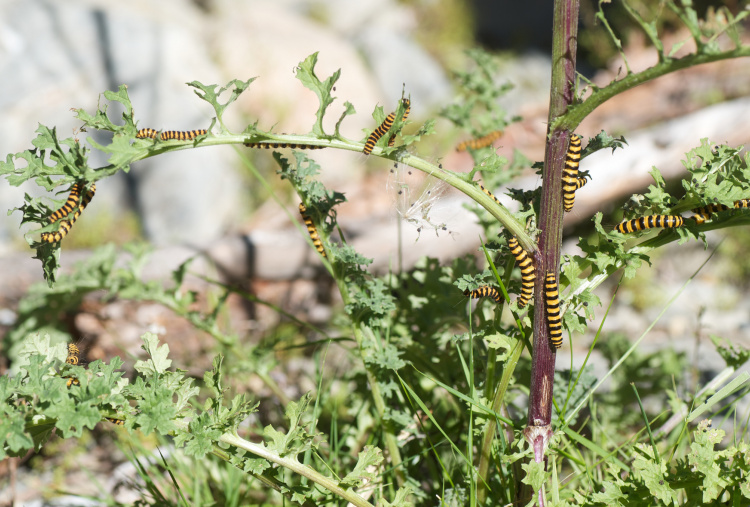
Ragwort is an attractive plant to many insects and for some rare species ragwort is an exclusive food source for others, such as the cinnabar moth, and as such has an important role in maintaining biodiversity.
It must always be considered a potential poison, but in areas where there are no livestock, or neighbouring farms it may be acceptable to leave ragwort untreated due to its ecological importance. See government guidance on how to identify areas according to their risk.